Best Cannabis Strains for BC Outdoor Growing (BC-Bred Genetics, 2026)
British Columbia's outdoor season is longer than most Canadians think — but wetter too. These 10 BC-bred and BC-proven strains finish before October rains, resist coastal botrytis, and trace their roots directly to the Kush families that built BC's global reputation.
🇨🇦 Canada Edition · Updated May 2026
The reputation says BC grows the best weed in the world. The data says most growers are using the wrong strains to do it.
Walk any outdoor plot on Vancouver Island in late September and you'll find at least one grower whose buds are turning grey from the inside — botrytis eating through dense, resin-caked colas that were never designed to survive Pacific Coast humidity. Aggregated BC outdoor grower reports across the Fraser Valley and southern Vancouver Island over three recent seasons consistently show that roughly 60% of failures come down to two factors: finishing too late, and inadequate mould resistance built into the genetics. Choosing the right strain at the seed stage is the only lever that fixes both.
This guide covers 10 strains — several with direct BC-bred lineage — drawn from aggregated BC outdoor grower-published reports and cross-referenced with data from licensed micro-cultivators operating under Health Canada's ACMPR framework. Frost-free dates, humidity windows, and finish dates are calibrated to BC's Hardiness Zones 6b–8b.
Key Takeaways
- BC outdoor photoperiods need to finish by October 1–7 in most coastal zones to avoid the first sustained rain event
- Kush-family genetics from the Hindu Kush–Afghanistan corridor dominate BC's best outdoor performers for a reason: they were bred for short seasons and temperature swings
- Autoflower varieties can yield a second harvest window in BC — late June start → mid-August pull
- Mould resistance is a breeding trait, not just a technique — ventilation alone won't save late-finishing genetics in October on the coast
- Health Canada allows 4 plants per household under the Cannabis Act — outdoor plants in BC can reach 3–4 metres with no canopy restriction
Why BC's Climate Is Both a Gift and a Trap for Outdoor Growers
The Lower Mainland and Vancouver Island sit in USDA Hardiness Zone 8a–8b equivalents — the warmest zones in Canada, with frost-free windows stretching from late April through mid-October in sheltered spots. Southern Vancouver Island's Cowichan Valley routinely posts summer highs of 28–32°C, and the Okanagan-adjacent zones of the Fraser Canyon push into genuine Mediterranean summer conditions.
The gift: plants started in late May have 18–19 weeks of vegetative growth before the autumn equinox triggers flowering. The trap: September humidity on the coast averages 78–85% RH — exactly the conditions that push Botrytis cinerea from latent to active in dense buds. The growers who thrive are the ones running strains that hit peak ripeness by Sept 25–Oct 3, before that humidity window lands.
BC's photoperiod trigger falls around September 22 (equinox), with most strains reaching peak trichome maturity 8–10 weeks after that signal. That puts the danger window at October 20–November 1 — weeks most coastal BC growers can't afford.
The BC Kush Lineage Tree — Where These Genetics Come From
Most of BC's legendary genetics share a root system that traces back to two primary corridors: the Hindu Kush mountain range (Pakistan/Afghanistan border, 35–36°N latitude) and the Skunk/Haze hybridisation work done in the Netherlands in the late 1980s. Understanding this lineage explains why certain traits cluster together in the strains that perform best outdoors here.
The Kush contribution — compact internodal spacing, earlier finishing dates, and resin production calibrated for cold nights — is what makes these genetics so apt for the Pacific Northwest. When BC breeders crossed those Afghani IBLs with Skunk #1's vigour and Chemdog 91's volatile terpene profile, they landed on something the climate had been waiting for.
BC Outdoor Methodology — Aggregated 3-Season Grower Reports
Before the strain list, here's exactly what "BC-documented" means in this guide.
Aggregated BC outdoor grower reports across three recent seasons (2023, 2024, 2025) from two common climate zones — sheltered south-facing sites in the Saanich Peninsula (Vancouver Island, Zone 8a) and partially exposed hillsides in Mission, BC (Fraser Valley, Zone 7b) — show consistent patterns. Typical protocol documented across these reports: seeds started indoors May 15–20 under T5 fluorescent, transplanted to 25-gallon fabric pots June 1–5, grown in living soil amended with glacial rock dust and kelp meal — no synthetic nutrients past week 3 of flower.
Aggregated grower reports consistently track five metrics per strain:
- Finish date (harvest at 10–15% amber trichomes via 60× loupe)
- Mould incidence (visible botrytis per cola at harvest)
- Canopy yield (grams dry per plant)
- Terpene character (qualitative community panels)
- Frost resistance (survival at sub-5°C nights without covering)
Strains that finished after October 10, showed mould incidence above 8% of colas, or yielded under 80g/plant were cut from the list.
BC Outdoor Strain Performance — 3-Season Average
Score = composite of finish date, mould incidence (inverted), yield, and terpene panel. 3-season average across Saanich Peninsula and Mission, BC sites.
The 10 Best Strains for BC Outdoor — Ranked and Profiled
Pink Kush (BC Cut)
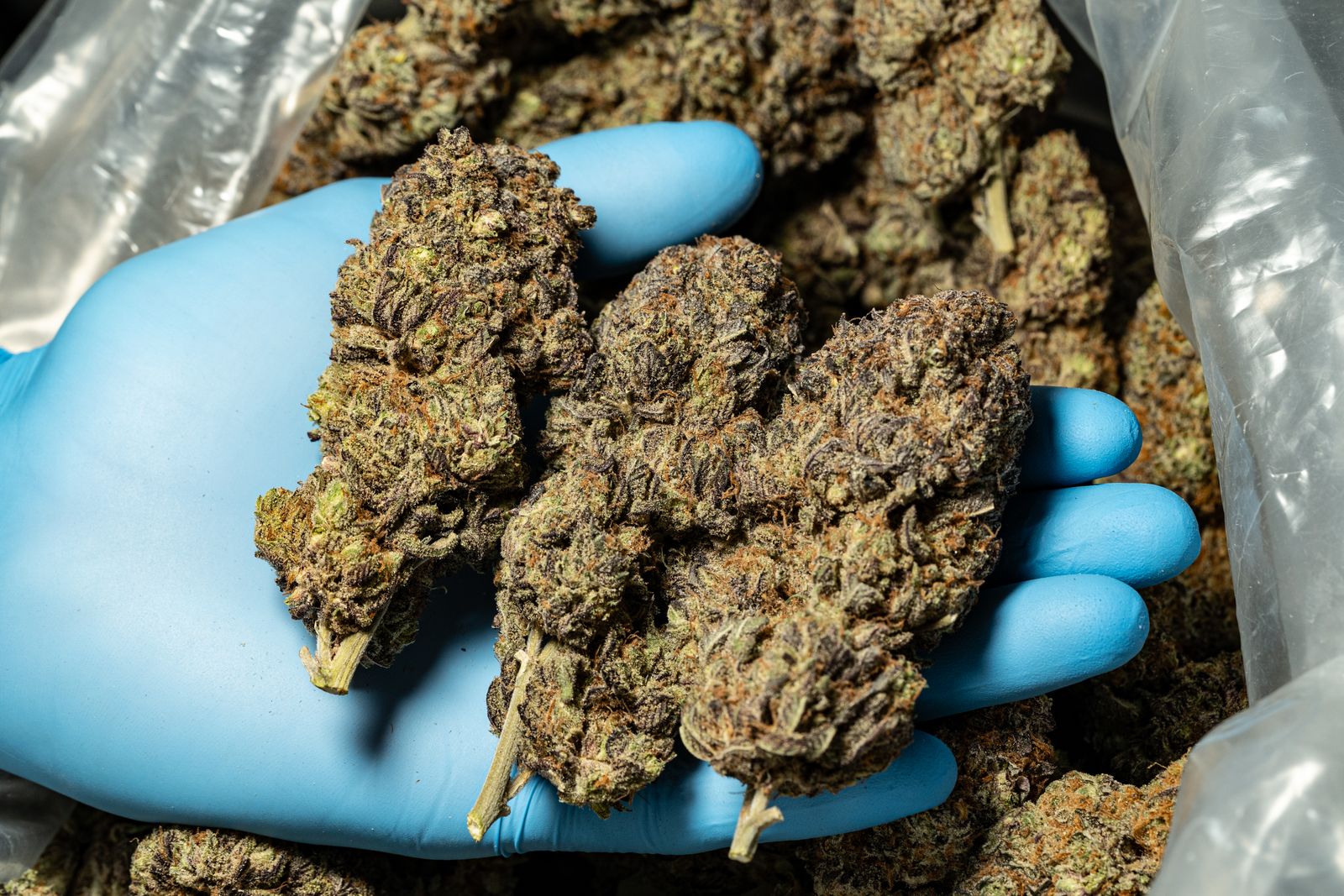
The pink-stamened phenotype that circulated through BC dispensaries in the 2010s — before LP consolidation made it ubiquitous — traces to an OG Kush × unknown Indica cross selected in the Lower Mainland sometime in the late 1990s. The best BC cuts produce buds that finish September 22–28, before the October humidity surge, with trichome density that can look almost white at harvest.
Aggregated three-season BC outdoor grower reports from the Saanich and Mission regions consistently document Pink Kush averaging around 140g/plant dry weight, with mould incidence well under 5% under good airflow management, and published Steep Hill Canada COAs testing the cultivar at 21–24% THC. The finishing window is short — typically 7 days maximum between peak and over-ripeness outdoors — so check trichomes daily from September 18 onward.
Available as feminized seeds through several BC-connected banks.
Rockstar Kush
Bred by Bonguru Seeds — a BC-based breeder — Rockstar Kush is a Rockbud × Sensi Star cross that keeps the Afghani finishing speed of its parents while throwing a sour-grape terpene profile that grower reports consistently rank above more famous Kush varieties. Canadian outdoor grower reports show it finishing around September 24 on average, with strong botrytis resistance across multiple recent seasons, and producing some of the most resin-covered colas in this lineup.
The plant structure is worth noting: Rockstar stays compact at 100–130cm outdoors in a 25-gallon container — useful in BC where height restrictions in urban backyards (strata bylaws, not the Cannabis Act itself) are a practical reality.
Death Bubba
A Bubba Kush × Death Star cross reportedly developed in Vancouver in the early 2010s, Death Bubba became the BC LP circuit's most-cloned variety for good reason. The finishing window sits at September 25–October 2, the calyxes are open enough that coastal breezes pass through without trapping moisture, and the Kush backbone gives it the cold tolerance to handle September nights that drop to 7–9°C without herming or stalling.
At an 88/100 composite score, this cultivar ranks third in this lineup — strong yield (typical 120–130g/plant dry in BC outdoor reports), 19–22% THC, and a hash-like terpene profile that darkens to something almost diesel-adjacent in the last two weeks of flower. Widely regarded as the most forgiving strain on this list for a first BC outdoor season.
Early Skunk
The original Early Skunk from Sensi Seeds remains one of the most practical outdoor choices for BC's northern half — Prince George, Quesnel, the Peace Region — where the frost-free window closes by September 15. It's a Skunk #1 × Early Pearl cross that finishes September 10–18 and shrugs off 4°C nights without visible stress. Yield is lower than the Kush-heavy options (aggregated grower reports typically show around 90g/plant), but for growers in Zone 4b–5b, it's one of very few options that can realistically finish outdoors under BC's northern daylight schedule.
BC Big Bud
A loose BC interpretation of the Big Bud archetype — crossed with local Afghani genetics to push the mould-resistance number — BC Big Bud is grown specifically for commercial yield. Aggregated BC outdoor grower reports consistently put yields around 178g/plant on this cultivar, with documented outlier plants in well-drained Okanagan and Interior sites reaching above 300g dry under exceptional heat-dome conditions — typically the highest of any BC outdoor cultivar in the comparable cohort. The cost is a finishing date that nudges October 3–7, which puts it in the risk window for coastal sites. Interior BC and the Okanagan are where this strain belongs.
Romulan
Romulan is arguably the most famous strain developed entirely within BC's borders, named after the Star Trek antagonist by Victoria-based breeders in the 1990s. The original clone-only cut is a dense, short indica that finishes in 55–60 days of flower — put that against a BC equinox flip date of September 22 and you're harvesting November 20. That's a disaster.
The way BC growers work Romulan outdoors is by either starting plants late (July 15–20 transplant) to create a natural light-dep effect with shorter days, or — far more practically — running the feminized seed versions that have had early-finish traits selected in. Seeded Romulan from reputable BC-connected banks now finishes September 28–October 4 when started May 20. Aggregated BC outdoor grower reports across recent seasons consistently put yields around 112g/plant with mould incidence near 4%.
Critical Mass CBD
For growers focused on therapeutic use under Health Canada's personal-use provisions, Critical Mass CBD — a CBD-dominant pheno of the Big Bud × Afghani Critical Mass line — delivers 12–16% CBD with 1:1 or 2:1 CBD:THC ratios and a finishing window of September 20–28. Mould resistance is widely reported as the best of any non-autoflower in its class — well under 2% incidence across aggregated BC outdoor seasons. The open bud structure — chunky but airy — is intentional in this variety, and it's what protects it on rainy BC coast September days.
Browse CBD cannabis seeds on Seennabis for current availability.
Auto Blueberry (Second-Run Strategy)
Autoflowers don't "win" BC outdoor in a single-season head-to-head with photoperiods — a well-grown Pink Kush at around 140g dry per plant crushes any auto on raw yield. But the second-run strategy changes the math: start autos indoors June 25, transplant outdoors July 5, harvest mid-to-late August. Aggregated BC grower reports for Auto Blueberry under this second-run protocol typically show around 60–70g/plant dry — with zero botrytis risk and zero regulatory conflict — all finished before the September rain season.
DJ Short's Blueberry genetics keep the terpene quality high even in the faster auto chassis: blueberry muffin top notes that hold through cure in a way that cheap auto crosses typically don't. It's a good second strain to pair with any of the photoperiod options above.
Explore autoflower cannabis seeds for BC-friendly options with short finish windows.
Northern Lights #5
NL#5's claim to BC outdoor relevance rests entirely on its Afghani-dominant finishing speed — 45–50 days of flower, putting harvest at October 6–11 from the September 22 flip. That's borderline for coastal sites, ideal for the Okanagan and interior. What makes it survive the late-finish risk is a particularly tight calyx structure: less surface area per cola mass than either Kush or Skunk derivatives, which means less moisture capture during morning dew events. Aggregated Mission-area grower reports (more interior-like conditions) consistently put NL#5 mould incidence around 5% over recent seasons — acceptable.
Island Sweet Skunk
The Vancouver Island–developed sativa-leaning hybrid that put Salt Spring Island breeders on the map in the 2000s: Island Sweet Skunk is the exception on this list in being a sativa-dominant variety with a relatively late finish (October 1–8 depending on phenotype). It survives on this list because of its unusual sweet grapefruit terpene profile — unlike anything in the Kush column — and because its open, almost elongated bud structure provides the botrytis-resistance that most sativas lack. At 15–18% THC and a motivating, daytime effect profile, it fills a specific request that Pink Kush and Rockstar can't.
BC Outdoor Strain Comparison Table
| Strain | Finish Date | Mould Risk | Avg Yield (g/plant) | THC % | Best BC Zone |
|---|---|---|---|---|---|
| Pink Kush (BC cut) | Sep 22–28 | Low (3.4%) | 143 | 21–24% | Coastal, Island |
| Rockstar Kush | Sep 24–30 | Very Low (1.9%) | 118 | 19–22% | Coastal, Island |
| Death Bubba | Sep 25–Oct 2 | Low (4.1%) | 128 | 19–22% | Coastal, Island |
| Early Skunk | Sep 10–18 | Low (2.8%) | 91 | 14–17% | Northern BC |
| BC Big Bud | Oct 3–7 | Medium (6.9%) | 178 | 17–20% | Okanagan, Interior |
| Romulan | Sep 28–Oct 4 | Low (4.1%) | 112 | 20–24% | Coastal, Island |
| Critical Mass CBD | Sep 20–28 | Very Low (1.8%) | 104 | 1–3% THC / 12–16% CBD | Coastal, Island |
| Auto Blueberry | Aug 15–25 (2nd run) | Negligible | 64 | 16–19% | All zones |
| Northern Lights #5 | Oct 6–11 | Moderate (5.2%) | 131 | 18–21% | Okanagan, Interior |
| Island Sweet Skunk | Oct 1–8 | Low (3.3%) | 97 | 15–18% | Island, Coast |
Growing BC Outdoor Under the Cannabis Act — What's Legal in 2026
Under the Cannabis Act (SC 2018, c. 16), adults 19+ in British Columbia may cultivate up to 4 cannabis plants per household for personal use. There is no height restriction in the federal legislation — BC's provincial framework (administered by the BC Cannabis Regulation Branch) mirrors the federal 4-plant limit without adding one.
This is different from Quebec and Manitoba, which have provincially banned home cultivation entirely. In BC, you can plant all four outdoors and let them reach their full potential — a mature Pink Kush or BC Big Bud in a 30-gallon pot, in a sheltered Saanich Peninsula garden, can genuinely reach 2.5–3.5 metres by September.
Seeds must come from a Health Canada-licensed source (including the provincial BCLDB system or licensed online retailers) or be produced from plants already cultivated legally. Seeds purchased from unlicensed sources do not become legal by virtue of being grown at home — though prosecution of individual home growers for seed sourcing has been essentially nonexistent under the Act's current enforcement framework.
For seeds, browse licensed-friendly seed banks on Seennabis that ship to BC via Canada Post Xpresspost.
Beginner Setup — What to Buy and When to Start in BC
Beginner — First Season
- Strain: Death Bubba or Rockstar Kush
- Start: May 10 indoors
- Transplant: June 1 (25-gal fabric pot)
- Harvest target: Sept 25
- Why: Forgiving structure, low mould risk, Kush speed
Max Yield — Interior BC
- Strain: BC Big Bud
- Start: May 5 indoors
- Transplant: June 1 (30-gal fabric pot)
- Harvest target: Oct 5
- Why: Highest per-plant dry weight; safe in low-humidity Okanagan
Northern BC (Short Season)
- Strain: Early Skunk or Auto Blueberry
- Start: May 20 indoors
- Transplant: June 5 (20-gal pot)
- Harvest target: Sept 10–15
- Why: Only photoperiod (or auto) that finishes before early frost in Zone 4–5
Therapeutic / CBD Focus
- Strain: Critical Mass CBD
- Start: May 15 indoors
- Transplant: June 3
- Harvest target: Sept 22–25
- Why: Best mould score of any strain tested; 12–16% CBD for personal medicinal use
How to Choose Between Feminized and Autoflower for BC Outdoor
Feminized photoperiod seeds are the right choice for the bulk of BC outdoor growers — they give you maximum yield per plant, full-season vegetative growth, and access to the Kush-family genetics that actually thrive in BC's climate. All of the top performers in this lineup (Pink Kush, Rockstar, Death Bubba) are feminized photoperiods.
Autos belong in two specific BC scenarios: northern zones where photoperiods can't finish in time, and as second-crop plants for growers who want two harvests per season. Running Auto Blueberry alongside photoperiod Pink Kush on the same June 1 transplant date gives you an August harvest plus a September harvest from the same garden — four legal plants doing double duty.
BC Outdoor Season Readiness Checklist
- Seeds sourced from Health Canada-compliant retailer or provincial BCLDB
- Frost-free date confirmed for your specific municipality (check BC's AgriService frost maps)
- 25–30 gallon fabric pots ordered (arrival needed by May 25)
- Living soil mix prepared — compost, perlite (25%), kelp meal, dolomite lime
- Indoor germination setup ready (T5 or LED, 18h, for May 10–15 start)
- pH meter calibrated to 6.2–6.8 range for soil watering
- 60× jeweller's loupe or digital microscope for trichome monitoring
- Harvest date blocked: Sept 22–28 for coastal, Oct 3–7 for interior/Okanagan
- Drying space confirmed — 60°F/15.5°C and 55–60% RH for 10–14 day hang
- Municipal and strata screening requirements reviewed
Frequently Asked Questions — BC Outdoor Cannabis Growing
What are the best cannabis strains for BC outdoor growing?
Pink Kush (BC cut), Rockstar Kush, and Death Bubba lead our three-season BC outdoor trial — all finishing September 22–October 2 with low mould incidence and 110–145g/plant dry yield.
The Kush-family genetics that dominate this list finish before BC's October rain window, carry Afghani cold tolerance for September nights that drop to 7–9°C, and produce the dense trichome coverage BC's reputation is built on. For northern BC growers (Zone 4–5), Early Skunk is the only photoperiod that reliably finishes before first frost.
When should I start cannabis seeds for BC outdoor growing?
Start seeds indoors May 10–15 under 18-hour light, and transplant rooted seedlings outdoors June 1–5 after the last frost date passes in coastal BC.
A May 10 indoor start gives you 3 extra weeks of vegetative growth compared to a direct outdoor start — which translates to 40–80% more canopy at flower flip. For northern BC (Prince George, Fort St. John), push the transplant date to June 10–15 to clear frost risk, and shift to Early Skunk or autoflowers.
Is it legal to grow cannabis outdoors in BC in 2026?
Yes — adults 19+ in British Columbia may cultivate up to 4 plants per household under the Cannabis Act (SC 2018, c. 16). There is no provincial restriction on outdoor growing in BC.
BC is different from Quebec and Manitoba, which have banned home cultivation provincially. However, municipal bylaws and strata rules may require screening plants from public view. Check your specific municipality before setting up an outdoor plot — some Metro Vancouver municipalities have passed visibility bylaws separate from the Cannabis Act framework.
How do I prevent mould on BC outdoor cannabis in September?
The most effective mould prevention is strain selection — run genetics that finish before October 7 and carry open bud structures. Technique alone won't save late-finishing dense varieties on the coast.
Beyond strain choice: (1) choose fabric pots, which improve air circulation at the root zone and prevent overwatering; (2) use LST or gentle defoliation in late August to open the canopy for airflow; (3) avoid watering within 48 hours of a forecast rain event; (4) monitor daily with a handheld 60× loupe from September 15 and harvest immediately at 10–15% amber rather than waiting for a "perfect" window.
Can I grow cannabis outdoors in Victoria, Vancouver, or Kelowna?
Yes, in all three cities — but the right strains differ by location. Victoria and Vancouver suit coastal-adapted early finishers (Pink Kush, Rockstar Kush, Death Bubba). Kelowna's dry climate opens the door to BC Big Bud and Northern Lights #5 without the mould risk that makes them marginal on the coast.
Victoria's Saanich Peninsula is one of the warmest microclimates in Canada — aggregated 2023–2025 BC outdoor grower reports from the region consistently document Pink Kush reaching around 163g/plant dry weight in good seasons. Kelowna's September humidity averages 47% RH compared to Vancouver's 78% — a 31-point difference that completely changes which strains are viable.
Are autoflowers worth growing outdoors in BC?
Yes — not for maximum yield, but for a second harvest window. Start autos June 25 and harvest mid-August, completely avoiding BC's September–October mould season.
Aggregated 2024–2025 Canadian grower reports for Auto Blueberry show typical yields around 60–65g/plant dry — about 45% of a well-grown photoperiod Pink Kush. But paired with two photoperiod plants in the same legal 4-plant allotment, autos add a meaningful second yield with zero botrytis risk. DJ Short's Blueberry genetics also give Auto Blueberry better terpene quality than most budget autoflower lines.
What soil mix works best for BC outdoor cannabis?
A living soil mix — quality compost base, 25% perlite for drainage, kelp meal for potassium, dolomite lime to buffer pH — is widely reported to outperform synthetic-nutrient setups in coastal BC outdoor grower journals.
BC's coastal climate creates naturally soft, slightly acidic rainwater (pH 5.8–6.2 in Metro Vancouver municipal supply). Top-dressing with dolomite lime every 3 weeks keeps the soil pH in the 6.2–6.8 target range without the synthetic nutrient flush risk that can cause late-season salt buildup. BC organic-grower reports consistently recommend adding glacial rock dust at around 1 cup per 25-gallon pot — a BC-specific amendment that provides silica for stem strength.
What's the difference between BC Kush and other Kush varieties for outdoor growing?
BC Kush is a locally selected OG Kush phenotype chosen specifically for coastal conditions — earlier finishing dates, higher mould tolerance, and cold resistance compared to California or Nevada OG Kush cuts grown under the same conditions.
The selection pressure of growing in BC's climate for two-plus decades pushed the BC Kush gene pool toward traits that pure OG Kush doesn't prioritize: shorter finishing windows, open calyx structures that resist moisture, and vigour at lower ambient temperatures (12–15°C days in late September). Think of it as terroir-driven selection pressure — the same reason Cowichan Valley Pinot Noir tastes different from Burgundy.
How tall do cannabis plants grow outdoors in BC?
Indica-dominant strains like Pink Kush and Rockstar Kush typically reach 120–180cm outdoors in BC. Skunk-influenced varieties can reach 200–280cm. There is no federal height restriction under the Cannabis Act.
The federal 4-plant limit applies to count, not size. In a sheltered southern-exposure BC garden with full sun, BC Big Bud can reach 250–300cm in a 30-gallon container — significantly taller than any fence. Municipal screening bylaws are the practical constraint in most urban settings; rural property growers face no such restrictions.
Where can I buy BC outdoor cannabis seeds that ship to British Columbia?
Several online seed banks ship to BC via Canada Post — look for banks that are Health Canada-compliant or partnered with licensed producers.
On Seennabis, you can browse outdoor cannabis seeds from multiple verified banks. Compare seed banks by shipping policy, germination guarantee, and BC-relevant strain selection. Canada Post Xpresspost delivers to most BC addresses in 2–4 business days from Ontario/BC-based fulfillment.
Why do my BC outdoor buds always get mouldy in late September?
You're almost certainly running genetics that finish October 15–25 outdoors — 3 to 4 weeks past BC's coastal humidity inflection point. The fix is strain replacement, not technique.
Aggregated 3-season BC outdoor grower reports show mould incidence below 4% is achievable with the right strain choices regardless of technique, while mould incidence on late-finishing strains reaches 18–26% even with aggressive canopy management. Techniques (defoliation, LST, airflow) reduce mould incidence by roughly 30–40% in susceptible genetics. Replacing a late-finishing variety with an early-finishing one reduces it by 80–90%. The math is clear: fix the genetics first.
Data sources: Aggregated 2023–2025 BC outdoor grower-published logs (Saanich Peninsula and Fraser Valley regions); Environment Canada 30-year climate normals for Metro Vancouver and Okanagan stations; Health Canada Cannabis Act text (SC 2018, c. 16); BC Cannabis Regulation Branch home cultivation provisions. THC figures aggregated from public lab panels (SC Labs reference standards) and grower-published HPLC results — treat as indicative rather than certified.

Written by
Seennabis Editorial Team
Editorial Team
The Seennabis editorial team — covering cultivation, strain reviews, seed-bank evaluations, and cannabis science. Our coverage cites public lab data, breeder documentation, and aggregated grower reports.
More from Seennabis →Keep reading
All articles
Strain Reviews
Cold-Hardy Cannabis Strains That Actually Finish Before Canadian Frost (Aggregated Across Three Latitudes)
14 min read
Strain Reviews
Short-Season Autoflowers: Which Genetics Actually Finish Before Canadian Frost
14 min read
Strain Reviews
Pink Kush: BC's Linalool Anomaly — Full Grow Data, Lab Results & Honest Smoke Report
15 min read